Showing posts with label Politics. Show all posts

Sunday, June 21, 2015

The misleading picture


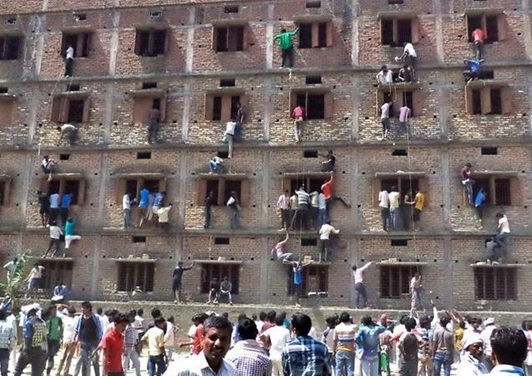
The picture above was recently in the news and more prominently in the circles of social media enjoying its ephemeral fame, prolific ridicule, widespread laughter and umpteen comments. Propped and enlightened by the comments of people on the social media, leaders gave their insightful views on how this “feature of society of Bihar” was bad and deeply crept in. Even the rugged veterans of Bihar politics, who are supposed to be deeply connected to the roots, made heartfelt appeals to the Bihari families to not allow their wards to cheat. The Education Minister felt that this malaise had grown so intractable that it couldn’t controlled by State alone. Former CM Lalu Yadav proposed a novel solution of open book exams so that cheating can be controlled. But I need to explain why this will not work.

A picture is worth a thousand words. However, in this case, I think a few hundred more are needed to explain the situation a little better. Since I spent my entire elementary and a bit of secondary learning in the state primary and high schools of my village in Siwan district of Bihar, I have witnessed the preparation of my seniors during state board exams. Different subject experts available in the village or in the vicinity were hired on corresponding exam days to sit near the exam centre. Rest of the family members or friends were there to take questions out to the subject expert and after he solved the questions, they took the cheat-sheets back to the candidates. I remember people inviting a venerable octogenarian Panditji of the village on the day of Sanskrit exam who went there only after much persuasion and a gift of silk dhoti. So, this hub-and-spoke model of knowledge supply chain was effective only when there was a subject expert sitting at the hub. Students sitting at the end of the spokes, who were used to be at the receiving end of the sticks, not knowledge during their classes, will still be clueless even if books are allowed in the exam.

It is amusing to see how the blame has been shifted so quickly and easily on the society. In reality, the picture represents the failure of our state in two specific realms. One is the quality of education in state schools of primary and secondary education. Going by the Annual Survey of Education Report 2014, around 86% of children 6-14 years of age are enrolled in government schools. Since 2009, the percentage of Std. V children who can read Std. II text in govt. schools has gone worse from over 56% to 41% in 2013 (comparative figure for private schools is 78%). Similar secular decline has been observed for arithmetic skills. Also, the high enrolment rates of 86% (that too is low in comparison to national levels) are not to be proud of; the attendance rates hover around 50-60% despite provisions of mid-day meals.

The quality of teaching in primary and upper primary schools of government is even worse. Compiled from various surveys, the teachers’ attendance rate in primary schools is around 83% and less than 80% in upper primary schools. This is on top of 40% vacancies in teaching personnel. Despite huge recruitment in recent years by Nitish govt., the qualification of teaching personnel has actually gone worse. Graduate teachers form only 40% of primary school teachers. Subpar salary offered in ad-hoc teaching schemes like Shiksha Mitra force teachers to engage in other activities for livelihood thus making teaching a secondary activity. In such scenario of state education, it is no wonder that students depend on cheating to pass in exams.

The other larger issue which this picture presents is of that of opportunity of livelihood. Bihar’s lagging economy and ineffective law and order stayed for a long time to eventually close its doors for private enterprise in the state. Agricultural economy has largely remained a subsistence activity despite acreage under food grains over 90%. According to the State Economic Survey 2014-15, no. of factories and workers employed, despite recent increases in last few years, have remained one of the lowest among all Indian states. Despite having immense potential for food processing, new private enterprises have been able to provide employment to only 6000 people in the sector during Dec 2013 to Dec 2014. Of the 28 sugar mills in the state, 18 are either sick or closed. In the last two decades, the major portion of employment offered was only by the State which obviously required minimum educational qualifications. Other areas of sports, art, drama and music which do not put much emphasis on educational “certifications” have not offered any avenues of livelihood generation. These conditions have instilled the belief, or rather fear, in people that educational “certifications” are a must for an employment opportunity, however bleak it may be. Such socio-economic conditions have led people to emigrate for employment search. And this emigration has been prominent not just in unskilled category but also in highly skilled professionals.

Hence, the solutions offered for the malaise represented by the viral picture are incorrectly aimed. Making invigilation strict or introducing open book exams or appealing to parents to instil ethics in their children are measures which are either misplaced or intentionally used to avoid blame. This is not difficult to understand when another picture of an examination centre of a CBSE or ICSE affiliated school is juxtaposed for comparison.


--
ps

Saturday, June 20, 2015

लोकतंत्र

ये जो तंत्र है
एक महान यंत्र है
ईवीएम के प्रयोग से
लगता, सभी स्वतंत्र हैं |

नहीं कोई षण्यंत्र है 
दिखता नहीं, नवीनता
आती हर पंचतंत्र है |

अपवित्रता बिल्कुल नहीं 
कहाँ से हो, जो रोज गाते 
ब्राह्मण असंख्य मंत्र हैं |

अशांति की कोई चिंता नहीं 
पंडित मौलाना, ख़ुशी से 
मिलते गले, निशस्त्र हैं |

नेतृत्व के नेता हम हीं
पूरे जगत को सीख दें
चूँकि सभी साधू-संत हैं |

कर्मण्यता का ज्ञान है 
एवं धैर्य की सीमा नहीं 
अतः, हर काम होता अनंत है |

चाचा सैम कुछ भी खोज करें 
पर ये हमारा अभियंत्र है 
यूनान को, आओ हम बताएं 
यही लोकतंत्र है, यही लोकतंत्र है |


--
ps

Friday, August 22, 2014

जय श्री राम

अच्छा, तो हिमालय पर्वतों की तीन श्रृंखलाएं हैं - हिमाद्रि, हिमाचल और शिवालिक। 


(नेपथ्य से) "जय श्री राम, जय श्री राम"


नहीं, नहीं। राम के नाम पर कोई नहीं है। सबसे दक्षिण वाली श्रृंखला तो शिवालिक है।


"जय श्री राम, जय श्री राम"


ओह, अब समझा, ये तो अंतर्मन की आवाज नहीं बल्कि बाहरी विश्व की पुकार लगती है। चलकर देखूं, इस भारतीय भूगोल की रचना से तो ज्यादा ही रोचक होगा। 


कम से कम बीसियों की संख्या में होंगे। बड़े ही युवा साधु हैं। गेरुए वस्त्र, हाथों में मोबाइल फ़ोन, कानों में माइक्रोफोन और जिह्वा पर राम का नाम - धर्म और आधुनिकता का ऐसा मिलन तो कम ही देखने को मिलता है। लेकिन, आज क्यों? पहले तो नहीं देखा इनको। आज कोई खास दिन है? आज तो शुक्रवार है। रामनवमी बीते भी काफी दिन हो गए। जरूर कोई और पर्व होगा। तारीख कौन सी है आज ?


16 मई, 2014 


ओह!


--

ps

Wednesday, April 3, 2013

Déjà vu - reliving the Indian National Movement

Facebook and other social networks are, these days, abuzz with posts from activists and supporters of Aam Aadmi Party (AAP) that over 7 lakh people in Delhi have signed the declaration form of non-payment of electricity bills. Making a safe assumption that all of them are above 18 years of age, hence already a voter or a potential voter, that amounts to around 7% of total voter population (going by the data of 1.07 crore eligible voters in 2008 assembly elections) which, by no means, is an insignificant amount.

Although you might and, most likely, will argue about the rise of Arvind Kejriwal as a popular public figure, the issues which he raises and his methods of protest. This article does not try to argue with you on that issue as the author himself is not a firm supporter nor a passive viewer although he does identify and gets inspired by the level of idealistic zeal and passion which Kejriwal reflects. But the author senses a striking similarity between, what he calls a "Kejriwal-Tide" (calling it a movement seems too optimistic) and the Indian National Movement (INM). The article tries to illustrate this remarkable similarity in the rest of the sections.

War of position

One of the most remarkably written books on modern Indian history, "India's Struggle for Independence" by Bipan Chandra et al., strongly asserts that INM was a "war of position" (the Gramscian thought of building hegemony over civil society through social institutions as opposed to war of maneuver where direct force is used). Although it seems impossible to imagine establishing counter-hegemony through war of maneuver in these democratic times where the state already enjoys a high level of legitimacy of all kinds, the examples of such methods are not difficult to notice, the naxal movements being the most prominent example.
Kejriwal's efforts in RTI and Lokpal issue utilize the war of position strategy where he tries to establish social and legal institutions which propagate and institutionalize the ideology he adheres to. His early days in Parivartan and RTI enforcement were spent mainly in mobilizing public opinion (especially in Delhi) which forms the basic strategic essence of war of position.

Co-opting the governing space

The national movement, primarily led by Congress, was not in complete isolation of what British Govt. offered in terms of governing space. Congress and other parties contested elections during 1937 after Government of India Act, 1935 was implemented. On similar lines, what Kejwriwal-Tide has adapted itself to is co-opting the democratic space offered by the constitution and hoping to drive the systemic changes from within the system. AAP has become the consequential agent through which he hopes to acquire that governing space.

Sinusoidal struggle phases

INM did not achieve its objectives in a particularly short period of time as the opposite has happened in French and Russian revolutions. It would also be totally wrong to assume that these momentary overthrows of status quo don't happen anymore. Arab Spring and its sister movements in Egypt, Tunisia, Libya, Yemen and Syria, whether successful or unsuccessful, have shown that to be possible in very recent history. But, INM was remarkable in the aspect that it was leavened with passive phases in between its active upsurges.
The Kejriwal-Tide has justified its literal meaning by flowing and ebbing in a similar fashion till now. The Lokpal and the current Delhi electricity bill issue have attracted the maximum participation apparently while mobilizing smaller albeit significant public support during Vadra, Gadkari and Ambani corruption exposures.

Civil disobedience

The recent "tactic" of Kejriwal to mobilize people to not pay the allegedly inflated public utility bills in Delhi might seem to many as attention grabbing and even illegal & seditious, but it certainly seems inspired from Gandhian method of civil disobedience to so much extent that it, even, is centered on breaking "tax laws" as was Dandi March on salt tax law. Whether this is just coincidence or Kejriwal has been deliberate his attempt, only time will tell.

On the hindsight, there were some signs which showed this trend such as using the term "satyagraha" for the protests and donning the Gandhi caps as protest symbols. Also, the support base for AAP and Kejriwal has been completely secular, broad-based and has relied on their normal strengths and weaknesses. Notwithstanding the disregard by people as well as veteran politicians, the Kejriwal-Tide has enabled people to participate from their homes and offices which, actually, is a very significant achievement, especially in the light of ephemeral participation which other issues get on social networks. As Gandhiji said, a leadership should not put undue strain on the energy of its support base and that is what this tide has been doing.